
One of the commonest complaints from any endurance athlete or marathon runner is muscle cramps and pain after their endurance feat. Before we contemplated our venture, we did our own surveys from athletes to understand what prevents them from pushing their limits. Or, in particular, what prevents them from training harder every day to achieve more.
SHOP our ELECTROLYTE POWDER
30-Day Satisfaction Guarantee
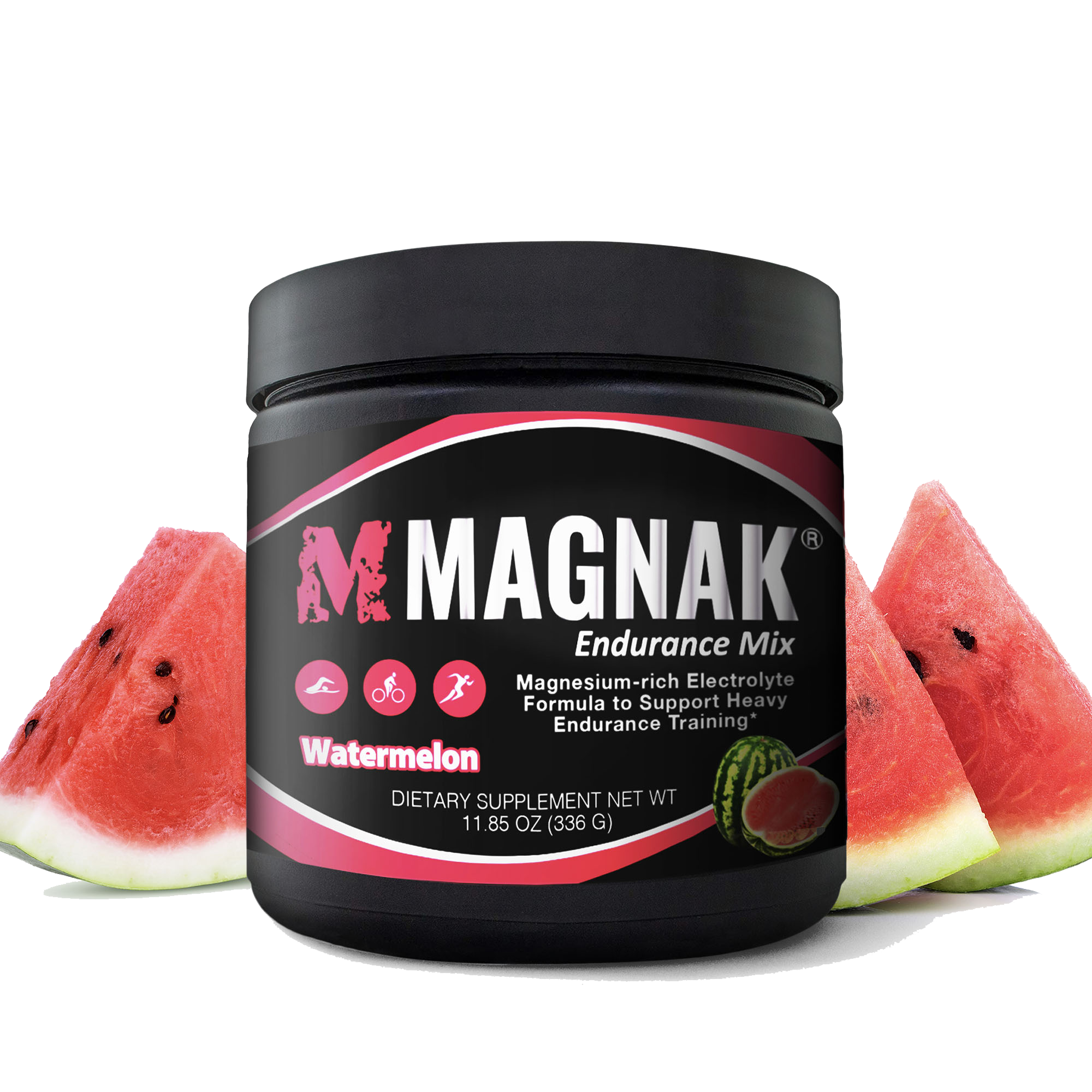

In our cohort of endurance athletes and martial artists, about 80% complained either of cramps or severe fatigue as leading causes that prevented them from training repeatedly the next day. What’s good for leg cramps?” was the most frequent question we received. This was partly our motivation to work on MAGNAK®, our unique magnesium-rich formula designed to prevent muscle cramps before they strike.

Formulated first in 2017, it has been refined since then to deliver the right proportion of electrolytes in a powdered mix, optimal enough to create an impact. Electrolytes are much more than minerals and every single one – sodium, magnesium or potassium, for example – is distinct in its action, volume of distribution, abundance, kinetics and its efficacy in exerting a desired effect within the body. Magnesium has been overlooked in its ability to help with muscle performance and is not a common electrolyte in sports drinks. In this article, we briefly examine the scientific theories underlying the physiology of cramps and some supplements for muscle spasms which may be beneficial in their prevention.

This theory about cramps is more foretelling about the actual action of cramping. That is, the muscle is in a hypercontractile state – in a way, the inhibitory reflexes from the nerves to the muscles, which usually would tell it to relax when the counter muscles are active, are not doing their job. When these excitatory impulses are uncontrolled, the muscle contracts and remains contracted in a way that eventually leads to a cramp. This is frequently why sports coaches often advise stretching muscles prior to an intense workout. Also, intuitively, most people who experience cramps often stretch it immediately to gain benefit. It works, in some cases. Repetitive and excessive activity leading to muscle fatigue is the commonest underlying inciting factor in these instances. This explains why, in some athletes, cramping is related to the duration of activity and the training status of the individual. The earlier in training, the higher the chances of muscle cramps. The limitation of this theory is that it explains the act of cramping, not the reasons behind it.
Many clinical observations have revealed that cramping, at least in some individuals engaged in intense physical activity, can occur from dehydration and electrolyte losses. High-intensity activities lead to a significant loss of water and electrolytes (mainly sodium) from the body in the form of sweat. This is affected by an individual’s sweat rate, dietary habits, rate of sodium loss in sweat, duration of exercise and the weather. When the body loses salt and water, the blood volume decreases. The perfusion or blood supply to the muscles drops as a result, and lactic acid (and probably other substances that we do not measure) accumulate in the muscle tissue, leading to a cramp. This had led to the usage of salty foods and interventions such as Pickle juice as supplements to prevent muscle cramps. However, some studies, have measured electrolyte concentrations in endurance athletes and have shown that these do not differ in those who cramp as compared to those who do not. One of the major problems with this study is that the electrolyte levels were measured after completion of the race, not during the race (which would be challenging in terms of a study design).


What Works and What Doesn't

Fairly popular in the 60s-70s, quinine (tonic water) has fallen off the radar as a preventive supplements for muscle cramps. This is largely due to the toxic side effects of quinine derivatives. Cases of quinine toxicity were identified worldwide, which led to a discontinuation of this compound in many countries, although anecdotal reports suggest that this was effective in treating some muscle cramps in selected individuals.
Vitamins for muscle cramps in general have not shown to be effective medications. However, in patients with kidney disease receiving dialysis, a clinical study has found that vitamin E, along with L-carnitine supplementation, improved symptoms of muscle cramps. Widespread use of these two agents in athletes is not studied, as most healthy athletes are not typically deficient in any of these. In the elderly, vitamin D supplements for muscle cramps in legs did not effectively prevent it at night. This further indicates that not all leg cramps are related to dehydration or electrolyte losses. Restless legs and nocturnal leg cramps in older individuals likely indicate a distinct underlying problem that is different from that seen in endurance athletes, hence why vitamins for leg cramps are ineffective in these cases.
Probably one of the most promising but yet “under-studied” minerals that can be effectively utilized for preventing muscle cramps is magnesium. It is the 4th most abundant mineral in the human body and is stored in the bone and soft tissues. Magnesium is constantly in a flux between the blood compartment as a free ion and influences more than 300 cellular reactions in the body. Magnesium deficiency has been shown to manifest as cramps, weakness, fatigue, irritability, headaches and mood disturbances. Magnesium has been tried in the relief of muscle cramps in the elderly without a conclusive outcome. It is commonly given to pregnant women with pre-eclampsia to relieve excessive uterine muscle contractions and carries a high safety profile. Very high doses of magnesium (that are now rarely utilized) have shown to inhibit neuromuscular reflex transmission and muscle contraction. Upon correction of clinical magnesium deficiency with supplements, individuals report improved muscle activity, lesser cramping and more energy in observational studies. Despite this, data from endurance athletes is less conclusive, largely due to a lack of properly controlled clinical trials to support it. Prior studies have not been able to control for dietary variation, variability of supplements, exercise regimen and tolerance of the individuals, as well as actual variable modifiers such as weather conditions that affect electrolyte shifts. A study on magnesium supplements for leg cramps of elderly individuals for a few months showed an improved ability to perform muscular tasks over a 12-week period.
If you had to ask what to take for leg cramps, magnesium seems to be a safe and effective bet.
Clinical studies have indicated that individuals using diuretics (water pills) for conditions such as heart failure leads to a depletion of potassium stores from the body. This has often led to muscle weakness and cramps, and potassium has been used as a supplement to relieve muscle cramps in these individuals. However, its role in exercise-associated muscle cramps is not studied. Normally, potassium is minimally lost in the sweat, and potassium often is seen to translocate out of the cells during intense exercise in a process called rhabdomyolysis (which literally means muscle cell injury). Thus, while individuals deficient in potassium (such as those using diuretics) may find relief with supplementation, it is unlikely that potassium alone can be the best thing for leg cramps in athletes.


Our own experience with our magnesium-rich formula, MAGNAK®, with several endurance athletes – including the 3-time world record holder James “the Iron Cowboy” Lawrence – has shown that regular magnesium supplementation prevents exercise-associated muscle cramps if given with a combination of other electrolytes, such as sodium and potassium. Most commercially available formulas rely on sodium, potassium and sugar in their recipe. MAGNAK® differs in its formulation by allowing 25% of recommended daily intake of magnesium per serving in a powdered (hence, easily absorbable) form. By correcting the subclinical magnesium deficiency seen in more than half of the adult American population, MAGNAK® improves the performance of athletes by reducing muscle cramps, soreness and minimizing fatigue.
Muscle cramps are complicated, and so are the theories underlying them. Although electrolyte depletion and dehydration are not the only reason for cramping, they certainly predispose endurance athletes to cramps.
Muscle fatigue and the resulting overactivity that leads to an uncontrolled neuromuscular response in some individuals play a large role in the actual process of cramping. But muscle (over)activity is the definition and, frankly, the purpose of an endurance race. So, if electrolyte-based rehydration techniques are one of the few modifiable factors, it is vital to fine-tune them to an athlete’s health benefit. And starting with a magnesium-rich electrolyte mix such as MAGNAK® is the best step in that direction.
Ready to try Speed Sauce? We're proud of our product and stand behind it 100%.



I've CRAMPED ENOUGH, TAKE ME TO MAGNAK
SHOP NOW